Off My Rocking Horse Logo header

Get Updates When This Shit Hits the Fan!

What I Learned After Trying to Be “Efficient”

What I Learned After Trying to Be “Efficient”

I’m convinced there are two kinds of people.

The first kind finishes a project with exactly one trip to the hardware store.

The second kind—my people—know every employee by first name before lunch.

For years I chased efficiency like it was some magical finish line. I bought organizers. I watched videos. I made lists. I even labeled bins with one of those fancy label makers because apparently that was supposed to fix my personality.

It didn’t.

One afternoon I needed to repair a loose fence board.

Easy enough.

Except the drill battery was dead.

The charger was in the house.

The extension cord was in the garage.

The screws were somewhere “safe.”

The tape measure had apparently grown legs and moved into another dimension.

By the time I actually tightened the first screw, I’d walked enough laps around the property to count it as cardio.

That’s when it hit me.

The problem wasn’t that I wasn’t organized.

The problem was that I was organized in all the wrong places.

Now I keep little stations where the work actually happens.

There’s a barn bucket.

A garden bucket.

A chicken bucket.

Even a porch bucket.

Do I own six tape measures now?

Yes.

Could I probably find all six?

Absolutely not.

But I usually find one of them exactly where I need it.

Sometimes the best life hack isn’t becoming more efficient.

Sometimes it’s accepting that Future You is just as forgetful as Present You and leaving yourself little gifts around the property.

It feels less like admitting defeat…

…and more like finally learning how to work with yourself instead of constantly fighting against yourself.

And honestly? That’s saved me more time than any productivity book ever has.


What I Learned After Trying to Be “Efficient”

What I Keep in the Barn So I Don’t Have to Make Six Trips Back to the House

There is a very specific kind of optimism involved in walking out to the barn empty-handed.

You tell yourself:

“I’ll only be out there for a minute.”

You know better.

Five minutes later, you need scissors.

Then a flashlight.

Then a clean towel.

Then the screwdriver you definitely remember leaving on the workbench.

It is not on the workbench.

So you walk back to the house.

Again.

At some point, I realized I was spending more time traveling between the barn and the kitchen than actually getting anything done.

That was when I started keeping a small collection of barn essentials exactly where I need them.

Nothing fancy.

Nothing worthy of its own organizing show.

Just useful things that save me from making six unnecessary trips back to the house.

A Good Pair of Scissors

This is first on the list for a reason.

Feed bags.

Baling twine.

Packaging.

Bandages.

Tags.

Random pieces of string that have somehow become part of a permanent barn fixture.

There is always something that needs cutting.

Keep one pair in the barn and label them if necessary.

Otherwise, they will disappear into the mysterious place where all scissors and single socks eventually go.

A Flashlight That Actually Works

Not the flashlight with weak batteries.

Not the one you have to smack against your palm three times before it flickers to life.

A real flashlight.

Keep fresh batteries nearby, too.

Because discovering that your flashlight is dead after sunset is the sort of character-building experience nobody asked for.

A rechargeable headlamp is even better when you need both hands free.

Work Gloves in More Than One Place

I keep gloves near the barn entrance and another pair near the tools.

Why?

Because the pair you need is always twenty feet away from where you are standing.

One pair is never enough.

They will get wet.

They will get muddy.

One will vanish.

Buy several inexpensive pairs and scatter them strategically.

Future You will be grateful.

Basic First-Aid Supplies

This does not need to be a full veterinary hospital.

A simple, clearly labeled bin can hold:

  • Gauze
  • Bandage wrap
  • Antiseptic
  • Disposable gloves
  • Saline
  • Scissors
  • Clean towels
  • Human bandages
  • A thermometer
  • Emergency phone numbers

Check the supplies occasionally and replace anything expired, empty, or suspiciously crusty.

The first-aid box is not helpful if it contains one dried-out wipe and a bandage from 2009.

Towels You No Longer Care About

Every household has towels that have reached the end of their indoor career.

They are stained.

The edges are unraveling.

Nobody wants to use them after a shower.

Perfect.

They have been promoted to barn towels.

Use them for spills, wet animals, muddy hands, equipment, and anything else you would prefer not to touch with your nice towels.

A Small Tool Kit

You do not need every tool you own.

Just the basics:

  • Hammer
  • Screwdrivers
  • Pliers
  • Adjustable wrench
  • Utility knife
  • Tape measure
  • Small level
  • Zip ties
  • Duct tape

The goal is to handle the ordinary little repairs without trekking back to the garage.

Will duct tape fix everything?

No.

Will that stop us from trying?

Also no.

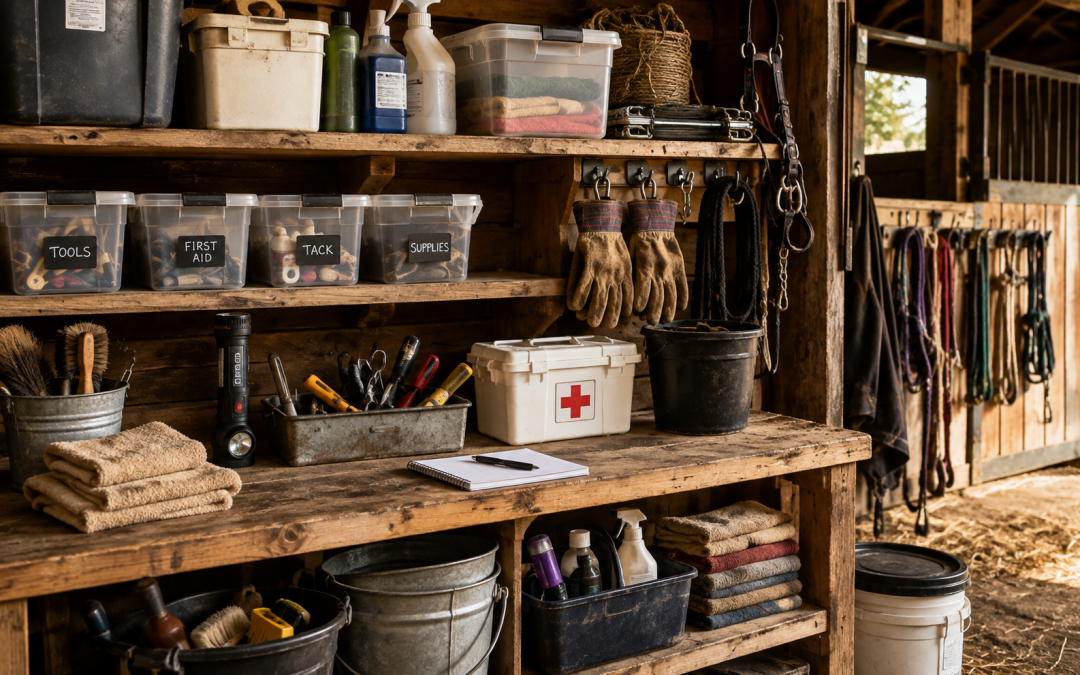
Hooks, Buckets, and Bins

The barn will gladly consume every loose object you leave unattended.

Hooks keep frequently used items visible.

Buckets hold brushes, sprays, tools, and odds and ends.

Clear bins work well for smaller supplies because you can see what is inside without opening six containers.

Labeling helps.

Whether anyone puts things back in the labeled bin is a separate matter.

A Notebook and Permanent Marker

Phones are useful until your hands are muddy, your battery is low, or you are wearing gloves.

A simple notebook works for:

  • Feed reminders
  • Supply lists
  • Appointment notes
  • Medication schedules
  • Repair measurements
  • Things you need to buy
  • Things you will absolutely forget by the time you reach the house

Keep a permanent marker nearby for labeling bins, buckets, feed containers, and anything else that needs a name.

Water and a Few Snacks

This sounds obvious.

It is not obvious when you went outside “for ten minutes” and suddenly it is two hours later.

Keep bottled water or a reusable bottle nearby.

A few shelf-stable snacks are also helpful.

Nothing dramatic.

Just enough to prevent you from making questionable decisions because you are hungry and irritated.

Sunscreen and Bug Spray

The sun does not care that you only planned to be outside briefly.

Neither do mosquitoes.

Keep both near the barn door so they are easy to grab on the way in or out.

If they are buried in a cabinet behind three feed buckets, you will never use them.

A Charging Cable or Portable Battery

A phone can be important for emergencies, photos, notes, weather alerts, and looking up why something is making that noise.

A portable charger or dedicated barn charging cable is worth keeping nearby.

Just store it somewhere dry and protected.

The Unofficial Emergency Repair Collection

Every barn develops one.

Mine includes:

  • Duct tape
  • Electrical tape
  • Baling twine
  • Zip ties
  • Extra clips
  • Carabiners
  • A few screws and nails
  • Spare hooks

Is this a professional repair system?

No.

Is it surprisingly effective at 7:00 in the evening?

Absolutely.

Keep the System Simple

The best barn setup is not the prettiest one.

It is the one you will actually maintain.

Do not create seventeen tiny categories unless that genuinely helps you.

Use broad groups:

  • First aid
  • Tools
  • Cleaning
  • Tack
  • Feeding
  • Emergency supplies

Make frequently used items easy to reach.

Put less-used supplies higher or farther back.

And resist the urge to save every broken buckle, empty container, and mysterious piece of hardware because it might someday become useful.

It probably will not.

Final Thoughts

Keeping the right supplies in the barn is not about having a perfectly organized space.

It is about reducing the number of times you stop what you are doing, sigh loudly, and walk back to the house.

A few duplicate tools, a flashlight, spare gloves, and some basic supplies can make barn chores much easier.

You will still forget things.

You will still lose the scissors.

And occasionally, you will walk all the way back to the house only to forget why you went there.

But at least it will happen less often.


7 Farmhouse Fixes That Cost Less Than Dinner Out

7 Farmhouse Fixes That Cost Less Than Dinner Out

Sometimes the projects that make the biggest difference aren’t the ones that require a contractor, a second mortgage, or an entire weekend of YouTube tutorials.

Sometimes they’re the little things.

The fixes that quietly make everyday life just…better.

These are a few of my favorites.


1. Replace Every Outdoor Light Bulb

Nothing makes a house feel neglected faster than burned-out lights.

Warm LED bulbs cost very little, last for years, and instantly make the porch, barn, and pathways feel welcoming.

Bonus points if they’re on a timer.


2. Paint the Front Door

Fresh paint works magic.

It doesn’t have to be a dramatic color.

Just fresh.

It’s amazing what one afternoon and a paintbrush can do.


3. Organize the Barn With Five-Dollar Buckets

Buckets solve more problems than most expensive storage systems.

Feed.

Twine.

Gloves.

Garden tools.

Dog toys.

Everything gets a bucket.

Label them.

Pretend you’ll keep them organized.


4. Plant Something That Comes Back Every Year

Perennials are the gift that keeps showing up.

You buy them once.

They reward you for years.

Unlike annuals…

who demand attention like needy toddlers.


5. Add Hooks Everywhere

Future You will appreciate Present You.

Coats.

Garden hats.

Dog leashes.

Extension cords.

Aprons.

If it hangs…

give it a hook.


6. Keep a Bench Near Every Door

Shoes.

Boots.

Mud.

Dogs.

Need I say more?

A simple bench quietly saves your floors.


7. Buy the Good Hose

Life is too short to wrestle with a hose that kinks every twelve feet.

Spend a little more.

Thank yourself later.


Final Thoughts

The funny thing about a home is that it’s rarely transformed by one giant project.

It’s changed by dozens of little improvements that slowly make life easier.

Those are the projects worth doing.

One inexpensive fix at a time.